
Myofascial Release: Expand Your Vocal Range (Of Motion)
If a singer can’t get their voice to move the way they want it to, it’s often not for lack of talent—their voice may just need more room to move. Myofascial release strategies can provide just that.


This article was first published in the January/February 2026 issue of VOICEPrints, the journal of the New York Singing Teachers Association. It is the third in a four-part series on how to use myofascial release techniques to condition vocal anatomy.
Why I Can’t Teach You How to Sing
All singers begin as self-taught. As with other movement and communication skills, we learn by exploring our bodies and imitating the comparatively more mature, experienced people around us. We respond to their feedback about whether the sounds we make are intelligible and pleasing. When our fledgling attempts at vocalizing are met with approval and encouragement, we are more likely to continue exploring our voices than when we are shushed up. Thus, the pleasure we take in these early explorations and the encouragement we receive from our listeners will factor more significantly into whether we are perceived as possessing “talent” than any inborn advantages our genetics might confer.
Voice teachers continually grapple with the widespread, persistent assumption that beautiful singing is the result of innate talent rather than a skill that can be developed. We may never succeed at persuading the world of the truth that most anyone can learn to sing. Unpacking the myth of innate talent nevertheless has the potential to make us better teachers, if we understand that among the qualities that define what we think of as innate talent is an absence of the physical tensions that commonly create resistance in the voice. Helping a singer to alleviate these tensions can reveal aptitude they never knew they possessed. Eliminating resistance can provide them with previously unavailable movement options and cause their voices to become more responsive and functional than weeks or years of vocalizing would be able to achieve were the resistance still present.
Vocal anatomy is much easier to coordinate when it is unencumbered by chronic physical tensions. If we regard these tensions as built-in features of a singer’s vocal anatomy, the best we will be able to do is teach them how to compensate for them via a series of effortful tweaks that deplete their stamina. But when we can help a singer to alleviate tensions encroaching on their vocal anatomy, good coordination often seems to just fall into place, as though the innate talent that was there all along is suddenly revealed.
I would argue that throughout our lives, progress in singing depends primarily on focused self-study. A teacher or coach can recommend exercises, explain how everything works, and offer feedback and encouragement. But meaningful progress is the consequence of a singer’s ability to notice the movements, sensations, and sounds involved in their own singing, and to intentionally evoke changes in the way their voice functions.
That is why I say that I can’t teach you how to sing. What I can do is teach you how to teach yourself to sing. I can describe and demonstrate the anatomy and biomechanics involved. I can help you interpret the sensory and aural experiences you have while singing. I can encourage you to keep at it when things get confusing or frustrating. However, as I will explain in this column, expanding vocal range, resonance, and dynamic options requires expanding range of motion for the components of vocal anatomy. If I can teach you how to expand range of motion for the components of your vocal anatomy, you will figure out how to expand your vocal range, resonance, and dynamic options.
Ultimately, each singer has to figure these things out for themselves because all the movements involved in singing occur within their body. Only the singer can sense where range of motion is limited. Only the singer can intuit where increasing range of motion will help them achieve their musical and expressive goals. A teacher or coach may be able to notice when things get stuck in a way that limits range, resonance, or stamina. They may even have some good ideas about where things are stuck and what needs to be released. But all they can really do is provide the singer with the tools they need to release whatever is stuck.
If a singer can’t get their voice to move the way they want it to, we shouldn’t assume it is for lack of talent—it is more likely the case that their voice just needs more room to move. Myofascial release strategies can provide just that.
A Larynx in a Vat
Students of philosophy eventually come across the “Brain in a Vat” thought experiment, which proposes that our embodied existence and experiences are merely illusions projected by a disembodied consciousness (see also The Matrix film franchise). I often think of the Brain in a Vat idea when contemplating laryngeal anatomy. It’s fairly simple to explain how the cricothyroid and thyroarytenoid muscles partner to modulate pitch and registration of the vocal folds, and it would be fairly simple to learn the necessary coordination… if what we were talking about were a Larynx in a Vat.
If our vocal folds were housed within a larynx floating freely in a large vat rather than our throats, without any nearby structures to encroach on its movements, we could theoretically adjust vocal fold length, thickness, and degree of adduction quite easily.
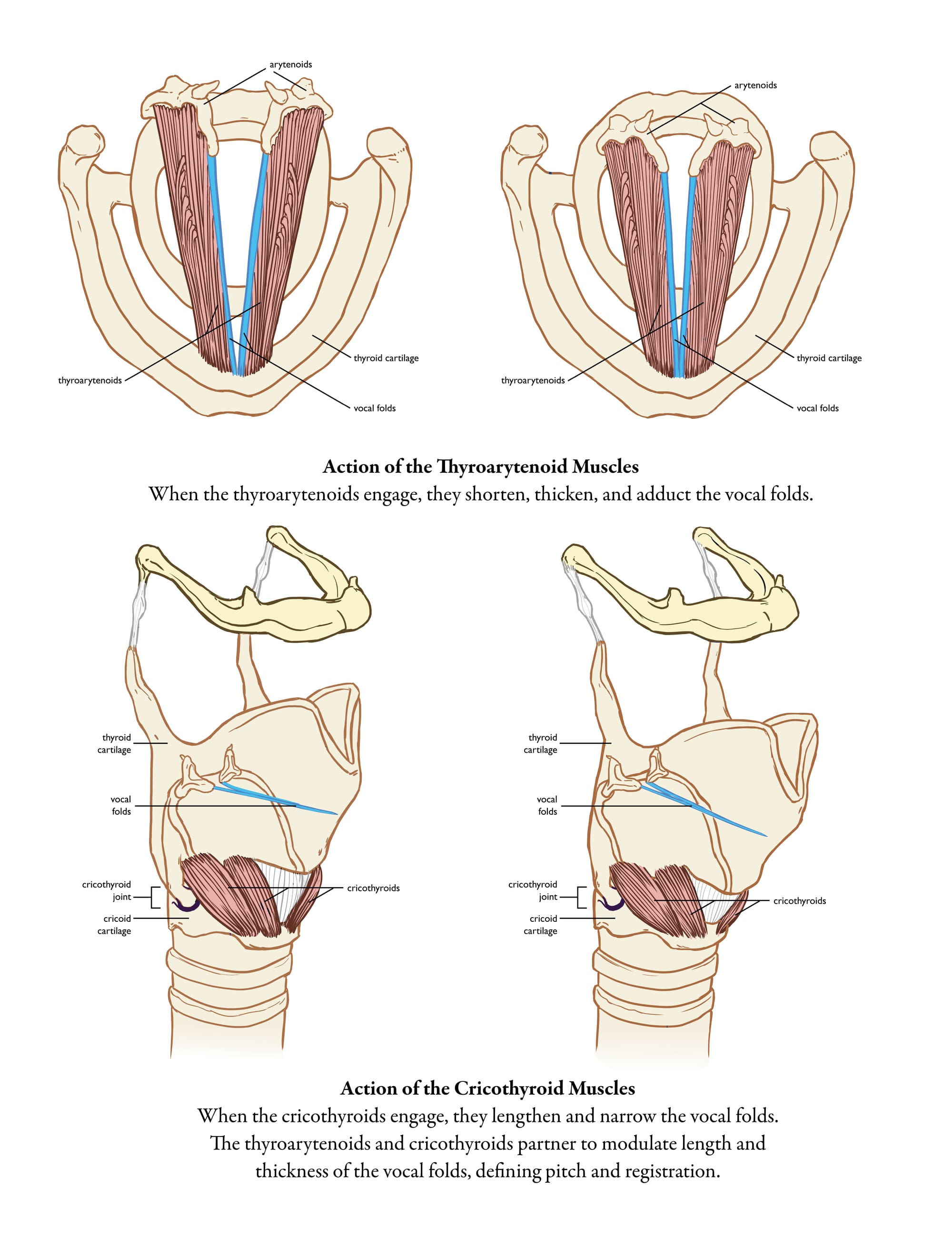
The highest note available to a singer is determined by how long and thin their vocal folds can safely and comfortably be stretched. What limits this is not poor flexibility of the vocal folds, but rather the extent to which the laryngeal cartilages are able to flex at the cricothyroid joints. Similarly, the ability to modulate registration seamlessly between heavy and light production depends far less on skill at “mixing” than it does on laryngeal freedom of movement. While skill at registration is something most singers must cultivate, good range of motion for the larynx thus facilitates the development of this skill.
Here is an exercise to explore your own laryngeal range of motion. I encourage you to watch my video demonstration of this exercise and try it out prior to engaging in any of the myofascial release strategies that follow, in order to determine what type of myofascial release will be most useful for you.
- Stand or sit with comfortable alignment that permits full breathing.
- Take a full, well-coordinated inhalation.
- Release your breath and perform a siren that traverses your entire vocal range. Begin on a low pitch with heavy registration, siren up to the top of your range while gradually modulating to very light registration, then siren back down to the bottom while modulating to progressively heavier registration.
- Notice whether your registration modulates seamlessly from heavy to light and back again, or whether there are moments when the registration changes suddenly (i.e. “cracks” on the way up or “clunks” on the way down).
- Notice whether your breath releases continuously or whether you mobilize your abdominal or other muscles to increase or decrease airflow and breath pressure.
- Notice whether your throat feels uniformly relaxed/engaged throughout the exercise, or whether some parts of your range carry more tightness or effort than others.
- Notice what sensations signal to you that you have reached “the top” and know that it’s time to turn around.
As you perform the exercise, note any areas where you experience uneven registration, surging or discontinuity of breath release, or areas of throat tightness, as well as any corresponding movements elsewhere in your body or your breathing. This helps identify where myofascial release will prove the most beneficial.
Myofascial Release Exercises for Laryngeal Range of Motion
Here is a series of myofascial release (MFR) techniques that can help enhance laryngeal range of motion. When laryngeal range of motion is impeded, it is usually not caused by tension in the structures housed within the larynx, but rather by the tissues and structures located outside the larynx. Therefore, most of the techniques that follow are not aimed directly at freeing up the structures that comprise the larynx, but rather at freeing up the structures around, above, and below the larynx that can encroach on the space it needs to move freely.
MFR Around the Larynx: Constrictors and Cervical Spine (i.e. your neck)
The muscles that surround and directly impact range of motion for the larynx include the constrictors and the digastric muscles. The constrictors are responsible for the wave of peristalsis involved in swallowing. The digastrics elevate the larynx, and their primary function also has to do with swallowing. Overactivity of either can limit range of motion for your larynx.
- Assess: Stand or sit with your neck relaxed and well-aligned. Place one hand gently across the front of your throat and the other against the back of your neck where it meets the base of your skull. Swallow a few times, noting any movements and sensations in the front and back of your neck. Hum or vocalize, noting whether this seems to result in engagement of the tissues whose movements you noted while swallowing.
- MFR for the Constrictors: Turn on a small massager and gently place it against the lamina of your thyroid cartilage without disturbing your neck alignment (either or both sides of your larynx will work fine). Swallow several times. MFR with external vibration is most effective when you hold the massager in one place while engaging and relaxing the muscles around it, so while it may feel good to move the massager around, I recommend holding it gently against your throat while slowly swallowing instead.
- MFR for the Digastrics: Turn on a small massager and gently place it against your left or right suboccipital muscleswithout disturbing your neck alignment (I recommend performing this movement on both sides of your neck). Swallow, and see whether you detect movement where the massager is positioned. Perform an ascending and descending siren and see if you can allow this area to remain relaxed while the pitch ascends and descends.
When the muscles that extend and flex your cervical spine become overactive, this can also limit laryngeal range of motion.
- Assess: Stand or sit with your neck relaxed and well-aligned. Watch yourself in a mirror and/or gently place a hand on the back of your neck. Perform an ascending and descending scale or arpeggio that traverses a significant portion of your vocal range. Note whether your neck remains relaxed and well-aligned, or whether it moves in tandem with your pitch change (i.e. arches up and back when the pitch ascends).
- MFR for the Cervical Spine: Turn on a small massager and gently place it against the side of your spine towards the top of your neck (either or both sides of your neck will work fine). Perform a slow, small nod “yes” at the position of the massager; then shake your head “no” side to side (again slowly) at the position where you feel the vibrations from the massager. Move the massager down one vertebra at a time and repeat the exercise until you reach the base of your neck.
MFR Above the Larynx: Hyoglossus and Supraglottal Tract
Most of the vocal anatomy with the potential to impede laryngeal range of motion from above are the structures involved in resonance and articulation, which will be covered more thoroughly in the final installation in this series of columns. However, the quantity of available resonance space and the quality of vowel definition are highly interactive with laryngeal range of motion, so I would like to introduce a couple of exercises to address these issues here. The hyoglossus is the muscle that retracts and depresses the tongue, so alleviating tension in the hyoglossus can have immediate payoff for improving laryngeal range of motion. Creating good resonance space within the supraglottal tract moves many of the tissues above the larynx farther away from it, which also facilitates improved laryngeal range of motion. This can be particularly helpful when working on modulating registration through a perceived “break” in the low middle voice, where it may be counterintuitive to create expansive resonance—a little extra room to move goes a long way for smoothing out registration in this part of the range.
- Assess for Tongue Tension: Stand or sit with your neck relaxed and well-aligned. Gently press your thumb against the underside of your jaw between your chin and your neck and massage the area gently so that it feels soft and relaxed. With your thumb in that position, perform an ascending and descending siren that traverses your vocal range. Note whether that area stiffens and presses against your thumb. If it does, you’ve got an overactive hyoglossus.
- MFR for the Hyoglossus: Turn on a small massager and gently place the tip where your thumb just was. Keeping your neck relaxed and well-aligned, slowly and repeatedly stick your tongue out all the way and then return it to a relaxed position. I find that many singers find it difficult or counterintuitive to perform this movement slowly—the slow, mindful movement of the tongue is key for releasing this characteristically overactive muscle.
- Explore Potential Resonance Space: Make yourself yawn and give your supraglottal tract a good stretch, noting how expansive that space can potentially be. Begin on a high note where you are accustomed to creating expansive resonance space and perform a siren down to the bottom of your range, noting whether your registration is well-modulated or you experience a sudden registration event or “clunk” as you approach the bottom of your range. If you find it difficult to modulate your registration smoothly towards the bottom, perform the descending siren again while attempting to allow the expansive space you created for the onset to continue to feel expansive while the pitch descends. Note whether this improves your ability to modulate your registration more smoothly into your low notes.
MFR Below the Larynx: Shoulders and Sternum
Two large anatomical structures that directly have very little to do with phonation can indirectly have a lot to do with impeding laryngeal range of motion. When the shoulders unintentionally and unnecessarily ascend during inhalation, it compresses the neck and crowds the larynx. When the sternum unintentionally compresses during singing, it causes the shoulders to internally rotate and the neck to extend, crowding the larynx in other ways. Alleviating chronic tension in these large structures will help improve laryngeal range of motion, but it is also crucial for singers to retrain their shoulders, sternum, and any poor breath coordination that entangles them so that they are no longer tempted to either elevate their shoulders or depress their sternums while singing.
- Assess: Stand or sit with your neck relaxed and well-aligned. While observing yourself in a mirror and/or inviting a friend to stand behind you with their hands on your shoulders, take some deep breaths while allowing your neck to remain relaxed and well-aligned. Do your shoulders elevate on inhalation? Now place a hand high on your chest, release your breath, and sustain a pitch within what you consider an easy range. Does your sternum remain where it is, or does it press downwards while you sustain?
- MFR for the Upper Trapezius: Lie face-up in a prone position on a mat with your feet on the floor, knees pointing up, and a book or pillow under your head (if necessary for neck comfort). Place two small massage balls under your upper trapezius on either side of your neck. Slowly press your heels into the floor and raise your hips up so that you are in a bridge position, then slowly rock back and forth and side to side over the massage balls and allow them to massage your upper traps. Because the upper trapezius is characteristically tight and overactive, you may find that just lying on top of the balls without bridging up is sufficient to feel some massage and release. Where myofascial release is concerned, it’s important to engage in these exercises at a level of intensity that feels really good—it’s counterproductive to push yourself to see how much you can tolerate.
- MFR for the Chest Muscles: Here is a video demonstrating how to use a medium massage ball to release the main muscles that compress the sternum (for which it is difficult to provide a solid narrative description, so please watch the video). Stand close to a wall or pillar. Position the massage ball on your chest midway between your armpit and your sternum and lean forward so that your body weight pins the ball against the wall. Slowly shift your weight side to side and up and down, allowing the ball to massage your chest muscles.
Myofascial release will not on its own eliminate habitual elevation of the shoulders or compression of the sternum. Changing habitual movements requires time, patience, keen observation, and repetition. But these myofascial release strategies are very helpful for eliminating chronic tensions and raising awareness of habitual movements.
Alleviate Resistance Rather than Compensating for It
When we attempt to move our voices in a specific direction but hit a limit where we feel stuck, the most instinctive and expedient way to keep going is to apply sufficient force to override whatever resistance we are met with. For example, a singer trying to perform a high note that lies outside their comfortable laryngeal range of motion may still be able to reach that note by amping up their breath pressure.
Myofascial release techniques offer a highly desirable alternative to the way singers too often end up pushing and pulling on themselves in order to support their sound. Rather than amping up their breath pressure to override throat tightness, they can learn to release the tissues creating that tightness. Rather than holding the larynx in a low position, they can learn to release the structures responsible for elevating it.
It may require time and exploration to identify and alleviate tensions that can limit range of motion for the larynx. But while there is no single protocol that will achieve this for every singer, each has within them the ability to begin to notice where resistance is impeding the flow of their sound, and to alleviate that resistance at the source.
Our vocal anatomy is a lot easier to coordinate when it is free of resistance. The less internal resistance we encounter, the more freely our innate expressive talent can flow.