Myofascial Release: Vibrate Your Way to Better Resonance!
The quality and intentionality of your articulation determines the quality and consistency of your resonance. Fortunately, our articulators are highly malleable and responsive to training.


This is the final column in a four-part series exploring myofascial release [MFR] and its applications in the voice studio. Part 1 provided an introduction. Part 2 covered the role fascia plays in breath support. Part 3 explored the ways in which myofascial release exercises can improve range of motion and coordination for the anatomy involved in phonation. This column offers myofascial release exercises for the anatomy involved in resonance and articulation.
VVT and Me
Throughout my teaching career, one of my core premises has been that singing is movement, and developing skill at singing is fundamentally a process of conditioning and coordinating our vocal anatomy. But it wasn’t until I encountered Vibrant Voice Technique [VVT] that I felt empowered to incorporate myofascial release into my studio teaching in a deep and meaningful way. Founders David Ley and Elissa Weinzimmer have created a highly effective system for freeing up the singer’s instrument, and I cannot recommend their methods highly enough.
The use of external vibration to release, activate, and introduce sensation into tight or dormant tissues has applications for many components of our vocal anatomy. However, the area where VVT has yielded the swiftest and most dramatic results for my students is without question articulation and resonance. Surely every voice teacher has experienced how stubborn jaw and tongue tension can be! It was such a revelation, to finally be able to offer my students a reliable resource for alleviating what I consider a nearly universal challenge for singers.
TL;DR, feel free to grab your massager of choice and skip to the exercise sequences (this is my preferred model, but this more affordable one will also do the trick). But I hope you will read on and learn why I find conditioning and coordinating our articulation and resonance anatomy to be so universal a challenge, and why I believe these exercise sequences can help your students rise to that challenge.
The Strongest Muscles in Your Body Are in Your Mouth
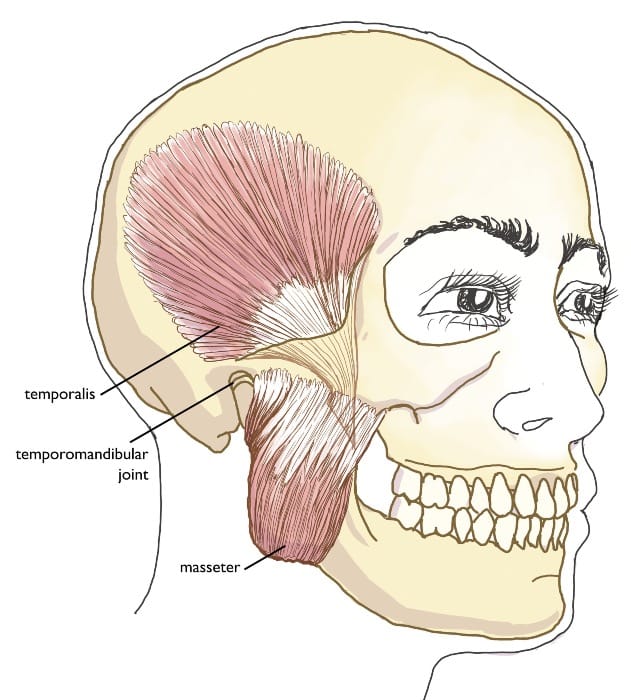
The masseter, the primary mover of the jaw, is the strongest muscle in the body by weight.
The anatomy that we use for articulation and resonance originated as components of our digestive system. Humans have been eating and drinking for far, far longer than we have been speaking and singing. Our evolutionary predecessors developed highly efficient jaws, tongues, and lips more than 200 million years ago, while homo sapiens are believed to have first acquired modern speech and language less than 200,000 years ago. We were developing skill and efficiency at chewing, sucking, and swallowing for a very long time before we discovered how certain components of our digestive system could also be useful for communication.
While our jaws, tongues, lips, and soft palates have evolved to be very good at multitasking, their primary functions remain the roles they play in digestion. Sure, it can be deeply frustrating to discover that you can’t define an “ah” vowel without your tongue retracting, but if you were to lose the ability to swallow, you could die. It may be insanely annoying if your jaw tightens up every time you articulate a consonant, but again, if you lose the ability to chew, you could die. Survival is the priority. What this means for us as singers is that we are endowed with very strong jaw muscles, very strong hyoglossi (the muscles that retract and depress the tongue) and comparatively weak orbiculares oris (the muscles that round the lips).
In my column on the benefits of myofascial release for the laryngeal anatomy, I mused that what we think of as the presence of innate talent is more indicative of an absence of the physical tensions that commonly create resistance in the voice. This is also true where our resonance anatomy is concerned. When we describe a person’s voice as “beautiful”, what we are usually describing is the quality and consistency of their resonance. Some singers instinctively figure out how to create expansive, consistent resonance for their voices, but this doesn’t mean they possess resonators that are inherently more beautiful than their peers. It just means that their digestive anatomy responds more readily to the multitasking demands singing places on it. All of us can train our resonators to amplify our voices beautifully and consistently.
What Is Vocal Resonance?
There are many elements that can potentially resonate our voices when we sing, including the acoustic of the room we are performing in, a microphone and amplification system, and our entire bodies. In this discussion, I am limiting my definition of vocal resonance to include only those elements that are both housed within our bodies and that we can coordinate and control. That means all the space above the glottis inside our throats, mouths, and noses, also known as the supraglottal tract. The way we shape this space filters and amplifies the vibratory signal produced by the vocal folds.
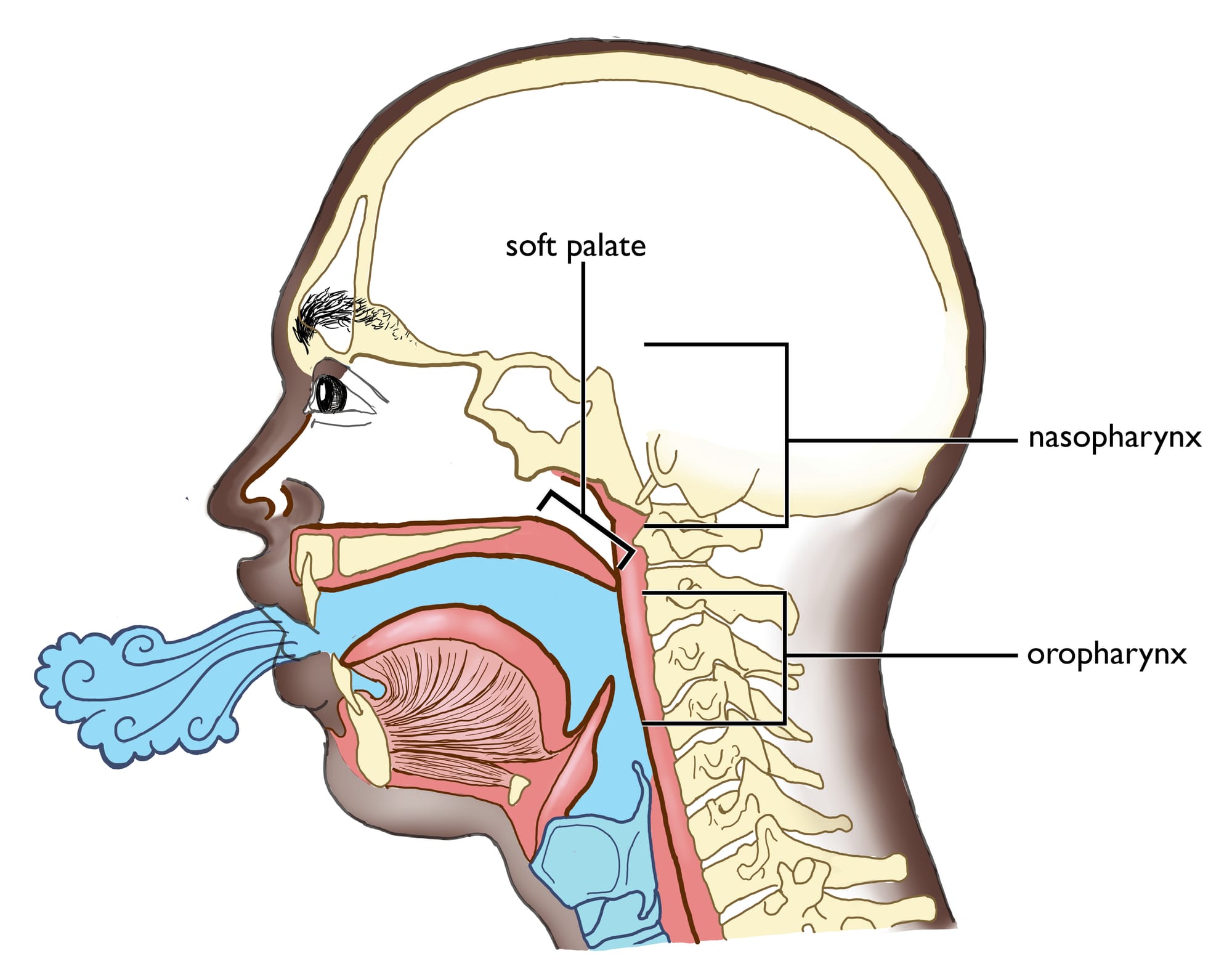
Vowel sounds are internal resonating shapes. We may sing full words, but it’s primarily the vowel sounds embedded in them that resonate the sustained singing voice. The two main factors that determine what vowel we produce are 1) the position of the hump of the tongue inside the mouth, and 2) the size of the mouth aperture, which can be more efficiently adjusted with the lips than with jaw movement. There is a lot more to vocal acoustics than I can cover in this column—if you are curious, I recommend Practical Vocal Acoustics, Ken Bozeman’s definitive work on the topic.
Consonants are produced by movements of the articulators that essentially decorate each sustained phrase of singing, ideally without interfering with consistent legato or resonance. The more swiftly and intentionally we engage in the movements required for consonants, the more they will support resonance and phrasing rather than interfere with them.
The quality and intentionality of your articulation determines the quality and consistency of your resonance.
The articulatory coordination we develop in service of intelligible speech is usually insufficient for creating effective, consistent resonance for the singing voice. Fortunately, our articulators are highly malleable, capable of moving fairly independently from one another, and responsive to training.
Myofascial Release Exercises for Articulation and Resonance
Here are some exercise sequences that condition and coordinate your jaw, tongue, and lips for more efficient articulation. The first step in each sequence assesses range of motion and coordination; the second step is myofascial release; the third is practicing efficient coordination in the comparatively friction-free environment the MFR helped create. I recommend brushing your teeth, scraping your tongue, and washing your hands prior to performing these exercises.
Jaw/Tongue Separation
Allowing the jaw to remain in a relaxed position most of the time helps create a consistent resonance chamber for all your vowels.
- Assess: Open your jaw to a position allowing for about one finger’s width separation between your upper and lower front teeth. While observing yourself in a mirror and pressing your palms or knuckles against your cheeks, say ah–nah–nah–nah [ɑ nɑ nɑ nɑ nɑ], using the tip of your tongue to articulate the n sound while leaving your jaw 100% relaxed and inactive. The assessment is simply, can you do it?
- MFR: Locate your masseter by placing your hands on either side of your face and noting where you feel a bulge when pressing your molars together. Turn on a small massager and hold the tip against the location where you found the bulge on one side. Begin with your jaw closed and then slowly open and close your jaw while holding the massager in the same location (external vibration is most effective when you leave the massager in place while engaging and releasing the muscle). Repeat this movement several times, noting whether the jaw is tighter on one side than the other and whether the movement is smooth or irregular.
- Practice: Repeat the movements used in the assessment. Say [ɑ nɑ nɑ nɑ nɑ], using the tip of your tongue to articulate the n sound while leaving your jaw 100% relaxed and inactive.
You can do it! You may need to go very, very slowly at first, but eventually you will train your jaw to only participate in articulation when you intend it to.
Hyoglossus Release
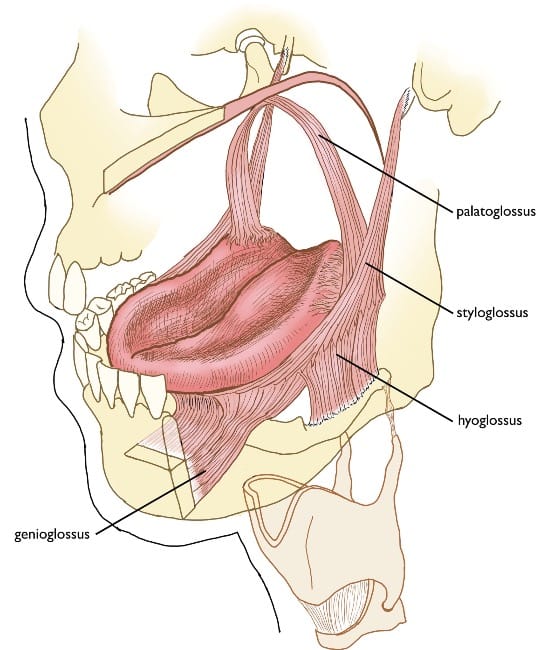
The position of the hump of the tongue is a key determiner of what vowel sound you are expressing. When the tongue is in a retracted position, there literally is no hump of the tongue contributing to vowel definition, necessitating effortful compensations from the assorted tissues inside your mouth and throat and usually resulting in unintelligible diction.
- Assess: Open your jaw to a position allowing for about one finger’s width separation between your upper and lower front teeth. While observing yourself in a mirror and pressing your palms or knuckles against your cheeks, say ah–æ–eh–ay–ee [ɑ æ ɛ e i] by shifting the hump of your tongue progressively forward in your mouth (again while leaving your jaw 100% relaxed and inactive). Can you do it?
- MFR: Turn on a small massager and gently press the tip against the underside of your jaw midway between your chin and your neck. Open your mouth while maintaining a long, relaxed position with your neck rather than craning your head back. Moving very slowly and continuously, stick your tongue out as far as you can and then draw it back into your mouth. Repeat this movement several times, noting whether the movement is smooth or irregular.
- Practice: Repeat the vowel progression used in the assessment. Practice saying [ɑ æ ɛ e i] by shifting the hump of your tongue progressively forward in your mouth while leaving your jaw 100% relaxed and inactive.
What I find most challenging about this exercise is that at first, the tongue may feel unwieldy and uncooperative, making it impossible to simultaneously practice the movements and audiate the vowel you intend. With practice, you will be able to pay attention to both, but at first, you may have to simply trust that there is a position that will yield beautiful definition for each of these vowels that does not include a retracted tongue.
Lip Rounding
The lips are very good at adjusting the size of your mouth aperture without compromising the size and shape of the internal resonance space. Because speech may accustom us to making this adjustment with the jaw instead, it is often necessary to practice engaging the lip muscles and integrating them into vowel definition while practicing allowing the jaw to remain relaxed.
- Assess, Part 1: Open your jaw to a position allowing for about one finger’s width separation between your upper and lower front teeth. While observing yourself in a mirror and pressing your palms or knuckles against your cheeks, say ah–awe–oh–ooh [ɑ ɔ o u] by progressively drawing the corners of your lips towards each other (again while leaving your jaw 100% relaxed and inactive). Can you do it?
- Assess, Part 2: Open your jaw slightly, relax your lips, and use your fingers to press the corners of your lips closer together (as in a fish face). Find the muscles that would hold your lips in that position without support from your fingers, and maintain the position without help from your fingers. Can you do it?
- MFR: Turn on a small massager and gently press the tip against the corner of your lips on one side. Slowly and repeatedly round and relax your lips.
- Engage: Place the soft underside of your palm just below the thumb between your lips. Engage your lips to form a seal around the area and then suck steadily on your palm, sustaining this movement for four to eight seconds and then relaxing.
- Practice: Repeat the vowel progression used in the assessment. Practice saying [ɑ ɔ o u] by progressively drawing the corners of your lips towards each other while leaving your jaw 100% relaxed and inactive.
The muscles that round our lips tend to be weak and underactive. When you first begin performing these exercises, you may find that your lips tremble a bit, similar to the way larger muscle groups fatigue from strength training exercises. But they will develop the requisite strength very quickly with a little bit of training.
A Ballet Class for Your Mouth
Ballet dancers learn and continually habituate the five fundamental foot positions that form the basis of classical dance. I often describe articulation training as analogous to this process. Dancers use their legs to carry them down the street and up and down stairs just like the rest of us, but when it is time to dance they condition their legs to conform to a very specific vocabulary of movement that supports the language of choreography they have specialized in. Optimizing articulation for singing is a very similar process.
Not all dancers study ballet, and not all singers perform classical repertoire, but all of us benefit from intentionally coordinating our anatomy to excel at whatever movements we think will best support our artistry. This column offers some general principles and introductory exercises for resonance and articulation. If you would like to do a deeper dive into these ideas, please explore my Articulation for Singers online course, which I am making available for free via this link to thank you for reading and encourage you to keep going!